One of the questions we hear most often is: “What’s the best form of exercise for the human body?” The honest answer is that there isn’t a single one — because it’s the wrong question to start with.
The reason there’s no clean answer is simple: the question itself is too broad. It’s the same as asking what the single best human diet is. The truth is, it depends entirely on the person — on how they live and what they want from their body.
A better question is: how do you want to live your life? Asked this way, we get much closer to the truth, because the answer naturally changes from person to person — shaped by values, goals, and desires. For example:
And the list goes on — shaped by different personalities and life goals.
However you’d answer, none of it is possible without one thing: physical health. Being able to move as much as you want, and to look after your own needs for as long as possible.
Physical health is the one thread running through every version of a good life.
Now we’re narrowing it down. It means:
In other words: a healthy musculoskeletal system and a healthy cardiovascular system.
Your body responds to the stimulus you give it:
That’s the whole idea behind Team8 Active: the right stimulus, applied safely and guided by our team, so you can keep living life the way you want to.
Exercise is meditation in motion. When you focus on the muscle you’re training, the breath, the range of motion — your mind arrives in the present moment with your body. The mind can travel anywhere; the body can only be in one place at a time. Strength training is one of the most reliable ways to bring them back together.
Most anxiety is the mind extrapolating into a future that hasn’t happened, or replaying a past that already has. The body is always now. Breathing now. Pressing against the floor now. Lifting now. When you make the body the focus, the mind has nowhere else to go — at least for a few minutes.
This is what meditation teachers have known for thousands of years. What strength training adds is intensity. You can’t focus on the muscle you’re training and also worry about tomorrow’s appointment. The demand of the present is too high. The mind quiets.
Sitting still and trying to ‘be present’ is one of the hardest practices in the world. The mind wanders within seconds. The body offers a much easier path: give it something physically demanding to do, and presence happens automatically.
This is why people often report feeling ‘clearer’ after a hard training session in a way they don’t after a meandering walk. The training demands attention. Attention is what they were missing.
The mind can travel anywhere. The body can only be in one place at a time.
You can deepen this effect by training with intention rather than autopilot. Notice the muscle you’re working. Feel the breath. Pay attention to the position of your spine, the contact of your feet, the tension in your hands. Each cue is an anchor.
Over time, that quality of attention becomes available outside the gym too. You start to notice the body during the day. You notice tension you can release. You notice when you’re shallow-breathing. The mind-body link, once trained, stays trained.
You don’t need to learn to meditate. You don’t need to download anything. You need two sessions a week where you commit to being inside your body while you work. The mental health benefits compound on top of every other benefit you’re already getting.
After a fall, the body usually recovers in weeks. The confidence takes longer. The brain becomes cautious — sometimes too cautious, and that itself becomes a risk factor for the next fall. Rebuilding confidence isn’t psychological alone: it’s about deliberately retraining the proprioceptive, balance, and reactive systems that keep you stable.
Most people understand that a fall can break a bone. Fewer understand the second injury that almost always follows: the loss of confidence. You start to move more carefully. You hold the rail. You decide against the bushwalk. You take fewer steps in a day. Your world quietly shrinks.
And here’s the cruel irony — the careful movement that protects you in the short term degrades the very systems you need for balance. Less walking means weaker muscles. Less varied movement means duller reflexes. Caution becomes its own risk factor.
Confidence in your body isn’t faith. It’s calibration. Your nervous system keeps a running record of what your body can and can’t do, and updates that record based on what you actually do. Stop challenging it, and the record updates downward. Challenge it appropriately, and the record updates upward.
This is why the right rehab after a fall isn’t rest. It’s progressive, varied, slightly-uncomfortable movement that gives the nervous system new evidence: yes, you can stand on uneven ground. Yes, you can recover from a wobble. Yes, you can move with momentum and not lose control.
The body recovers in weeks. The nervous system needs a deliberate retraining.
Step one: a thorough assessment to identify where balance and reactive systems are actually impaired (vs. where you’ve just become cautious). Step two: a graduated program that systematically rebuilds capacity in those specific areas. Step three — and this is the underrated one — repeated exposure to the kind of movement contexts that previously felt risky.
Walking on grass. Stepping over things. Changing direction. Reaching while standing. The point isn’t to make you do these things in your daily life with your eyes closed. It’s to make your nervous system believe, with evidence, that you can.
If you’ve had a fall or near-fall, the worst thing to do is wait it out. Confidence doesn’t return on its own. It returns through deliberate, supervised challenge to the systems that keep you upright. We’ve helped a lot of people walk back into their lives after a scare. The journey back is shorter than most people think.
Three things shift gait with age: balance, joint stiffness, and muscle weakness. Stride length shortens, walking speed drops, posture changes. All of it is preventable and reversible to a significant degree. A professional gait assessment shows you exactly where your walking is breaking down and what to train.
Walking looks simple. It’s not. Every step is a controlled fall — momentum carries you forward, one leg catches you, the other swings through, your trunk rotates, your arms counter-swing, your eyes scan ahead, your inner ear stabilises. Hundreds of micro-decisions per minute, all happening below conscious awareness.
When that integration starts to degrade — even slightly — the whole system compensates. Stride shortens to give you more time. Speed drops because the system is less confident. Posture shifts to keep you over your centre of gravity. None of it feels like a problem until one day, it does.
First, balance. As the vestibular and proprioceptive systems become less precise, you walk more carefully — less heel-strike, shorter stride, less push-off through the toes.
Second, joint stiffness. Hips, ankles, and the thoracic spine lose range. You walk with less hip extension, less ankle dorsiflexion, less trunk rotation. The whole gait becomes more ‘mechanical.’
Third, muscle weakness — particularly in the glutes, calves, and core. Without sufficient push-off and stability, you take smaller, more cautious steps.
Walking speed is one of the most reliable predictors of healthy ageing. It’s also one of the most trainable.
At Team8, our physiotherapists watch you walk on video, slow it down, and identify exactly where the system is compensating. Maybe your right hip isn’t extending. Maybe your left calf isn’t pushing off. Maybe your trunk is rotating less than it should. Each finding maps to a specific training intervention.
This is the gap between general ‘walk more’ advice and an actual rehab program. The first treats the symptom. The second fixes the cause.
The good news is that gait responds quickly to targeted work. Mobility for the stiff joints, strength for the weak muscles, balance for the cautious nervous system. Within 6-12 weeks, most people see measurable changes in stride length and walking speed — and they feel it: walking feels easier, longer walks become possible again, stairs feel less like a task.
A meaningful goal doesn’t have to be giant. It can be as simple as getting down to the floor and standing back up comfortably, or climbing two flights of stairs without holding the rail. The desire for that goal has to outweigh the daily temptations to skip training, take the lift, follow the easier path.
Most fitness goals are too abstract to compete with the very concrete temptations of daily life. ‘Get healthier’ loses to a comfortable couch. ‘Get fitter’ loses to a busy Tuesday. The goal needs to be specific enough that you can feel it pulling on you in the moment of decision.
Concrete beats abstract. Specific beats general. A small, vivid, achievable goal will pull you through more sessions than a giant vague one.
The best goals are the ones that connect to something you want to keep doing in your life. Playing on the floor with grandchildren. Carrying your own bags through airports. Walking the coastal track on holiday. Gardening for three hours without paying for it the next day.
Each of these is small enough to be specific, but big enough to matter. When the alarm goes at 6am and you’d rather sleep, ‘I want to stay strong enough to keep gardening’ has more pull than ‘I want to be healthy.’
Pick a goal you can feel pulling on you when you’d rather stay in bed.
You’ll skip sessions. Everyone does. The question is the long-term ratio. If you train twice a week for fifty weeks, you’ve done a hundred sessions. Miss ten and you’ve still done ninety. Miss thirty and you’ve still done seventy.
The goal isn’t to never skip. The goal is to make the default ‘show up’ instead of ‘skip.’ The right goal makes that default easier to hold.
The single most underrated piece of advice for sticking with training: write your goal on a piece of paper and put it where you’ll see it. Bathroom mirror. Inside of a cupboard. Wherever you’re going to be in the morning. The act of seeing it daily is a quiet form of training in itself — the goal stays alive in your mind, ready to outweigh the next temptation.
Hip replacement is one of the most successful orthopaedic surgeries ever developed. But it’s still major surgery, and it’s reasonable to want to avoid it. The problem: by the time hip arthritis becomes painful, surgery is often unavoidable. Prevention has to start years before the first sign of pain.
The cartilage in your hip doesn’t have nerve endings. It can wear down significantly before you feel anything. By the time the joint starts producing pain, you’re typically dealing with bone-on-bone contact, capsule inflammation, and altered movement patterns that have compensated for the underlying problem for years.
This is why ‘I felt fine until last year’ is such a common story. The hip wasn’t fine. The signals just weren’t reaching consciousness yet.
Genetics plays a role, but lifestyle plays a bigger one. The biggest contributors are: weak glutes (which lets the femur grind in the socket), tight hip flexors and capsules (which alter joint mechanics), insufficient hip extension during walking (which loads the joint awkwardly), and decades of sitting (which trains all of the above).
None of these are ‘just ageing.’ All of them are modifiable. The earlier you intervene, the more the joint can be preserved.
By the time hip arthritis hurts, the joint has been quietly degrading for a decade or more.
A proper hip program isn’t just ‘stretches.’ It’s targeted strength for the glutes (deep and superficial), mobility work for the hip capsule and flexors, gait retraining, and movement patterning that loads the hip well. Done properly, it can dramatically slow the progression of mild-to-moderate arthritis and reduce symptoms substantially.
Even with significant arthritis, conservative management can often delay surgery by years — sometimes indefinitely. And if surgery does eventually become the right choice, the strength you’ve built makes recovery faster and the result better.
Pain doesn’t mean the joint is destroyed. Many people with significant arthritis on imaging are pain-free, and many with painful hips have only mild changes on imaging. What matters is how your specific hip is moving and loading right now — and that’s exactly what a thorough physiotherapy assessment reveals.
Don’t wait for things to get worse. The earlier the intervention, the more options you have.
If a clinician tells you your pain is “just arthritis” or “just old age” and sends you home with a script and no plan, that’s a clinician who has expired their own usefulness. Ageing isn’t a diagnosis. It’s not a life sentence. There’s almost always something you can do, and someone whose job it is to help you do it.
Some of it is time pressure — a GP with fifteen minutes can’t open a full conservative-management discussion for every patient with hip pain. Some of it is therapeutic nihilism — clinicians who haven’t kept up with the evidence on what’s possible for older adults.
Whatever the reason, the result is the same: a generation of people who’ve been told their bodies are simply running down, and who’ve accepted it. The cost is decades of unnecessary suffering and decline.
Almost always, ‘just old age’ is a label for something more specific that wasn’t diagnosed. Knee pain at 70 isn’t ‘just old age’ — it’s likely a combination of arthritis, weak quadriceps, altered movement patterns, and possibly meniscal changes. Each of those has interventions.
Tiredness isn’t ‘just old age’ — it’s possibly poor sleep architecture, low protein intake, declining muscle mass, possibly thyroid or vitamin D issues. Investigable, treatable.
Stiffness isn’t ‘just old age’ — it’s reduced movement variability over years. Trainable.
If a clinician shrugs and calls it ageing, they’ve stopped doing their job. Find someone who hasn’t.
Specific complaint identified clearly. Examination of the joints, muscles, movement patterns involved. Discussion of what’s contributing. A plan that includes things you can do (not just things to take). A timeline for review.
If pain or stiffness or weakness is being labelled ‘ageing’ without that level of investigation, you’re being undersold.
Most decline that’s blamed on age is actually decline of disuse, deconditioning, and underdiagnosis. The body keeps adapting at any age — it just needs to be asked to. The clinician’s job is to identify exactly what’s needed and help you do it.
If yours isn’t doing that, we’d love to.
Worry doesn’t disappear with exercise. But movement gives you control over how much it affects you. Push, pull, and lift — when you put your physiology through purposeful effort, the mind follows. People walk out of strength sessions reporting less anxiety, more focus, and a measurable shift in how grounded they feel.
Resistance training triggers a cascade of measurable changes: increased BDNF (a protein that supports neuron growth), elevated mood-regulating neurotransmitters (serotonin, dopamine, noradrenaline), reduced cortisol over time, and improved sleep architecture. Each of these has independent effects on anxiety and mood.
Together, the effect is large. The most robust meta-analyses on resistance training and depression show effect sizes comparable to first-line therapy and antidepressants for mild to moderate cases. That’s not ‘a bit better than nothing.’ That’s clinically meaningful change.
Walking, cycling, swimming — all of these help. But there’s something particular about lifting heavy things. Maybe it’s the focused effort, the demand for full presence in the body. Maybe it’s the evidence of progressive capability over weeks and months. Maybe it’s just that you can’t think about your inbox when you’re under a loaded bar.
Whatever the mechanism, the people we work with consistently report that strength sessions deliver something a walk doesn’t. They arrive distracted and leave settled. They arrive heavy and leave clearer.
You can’t think your way out of a stuck mood. Sometimes you have to lift your way out.
Most general gym sessions aren’t intense enough to deliver the mental health effect. You need to actually work — meaningful loads, real exertion, full focus. That’s hard to push yourself to alone. It’s the supervision that makes it work for most people.
Our small classes are built around exactly this: enough intensity to matter, enough support to keep it safe, enough variety to keep it engaging. You leave having done something real with your body, which leaves your mind with somewhere to land.
You don’t need to feel motivated to start. You need to show up twice a week and let your body do the rest. The mood shift compounds: the better you feel after, the more you want to come back, the better you feel. Strength sessions become the part of the week you stop trying to skip.
Age-related muscle loss isn’t inevitable — it’s a default we can opt out of. Resistance training (push, pull, lift) is the most effective tool we have to maintain and even rebuild muscle after 50. Load it, demand more from it, and your body responds: you keep your strength, your independence, and the everyday capacities that compound into ageing well.
Sarcopenia is the gradual loss of muscle mass and strength that accelerates from around age 40. Most people lose between 3-8% of their muscle mass per decade after 30, and that rate accelerates after 60. It’s quiet, slow, and easy to miss — until something simple becomes difficult.
It shows up in things you stop doing. The grandchild you can’t pick up. The shopping bag that feels heavier than it used to. The stairs you take more carefully. None of these are ‘just ageing’ — they’re symptoms of muscle that has been allowed to fade.
The body adapts to what’s asked of it. If less is asked, less is maintained. Modern life asks less of our bodies than at any point in human history. Combine that with hormonal changes, reduced protein intake, and a few decades of underloading, and muscle quietly disappears.
But muscle is one of the most adaptable tissues we have. The research on resistance training in older adults is now overwhelming: people in their 70s, 80s, and 90s can build measurable muscle within 12 weeks of progressive strength work. The body keeps the door open. It’s just waiting to be asked.
Strength isn’t something you lose with age — it’s something you stop training.
The protocol isn’t complicated. Compound movements (squats, deadlifts, presses, rows) two to three times a week. Loads that genuinely challenge you — not ‘lifting’ five kilo dumbbells in front of the TV. Enough recovery between sessions for adaptation.
What’s hard isn’t the science. It’s the supervision. Getting the right load, the right form, and the right progression for your body is where most home programs fail. That’s the gap our personalised programs fill: a physiotherapist or exercise physiologist watching your specific body move, and adjusting in real time.
Strength is the bedrock of independence. Carrying groceries. Getting up from a low chair. Catching yourself when you trip. Bending to garden. Lifting a suitcase into an overhead locker. All of it runs on muscle that you maintained — or didn’t.
The best time to start was twenty years ago. The second-best time is this week.
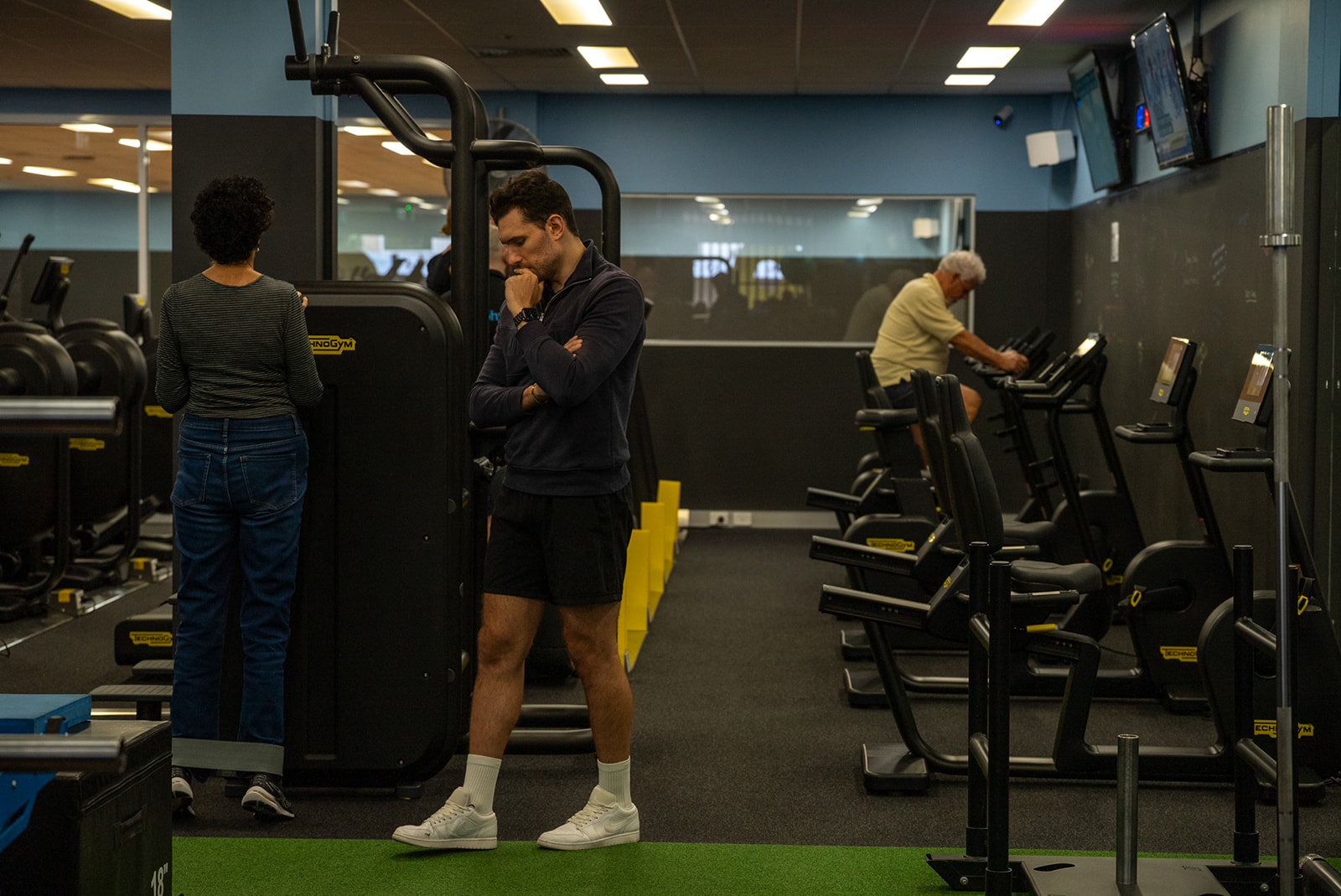
Walking into a gym for the first time is uncomfortable for everyone. Lifting weights is intimidating. Your brain is wired to protect you from the unknown — every cell will push you away. We’ve removed most of that early friction at Team8: small classes, supervised by health professionals, no judgement, no ego, no feeling self-conscious.
Most people who would benefit from strength training never start. The barrier isn’t physical capacity — it’s the friction of the first session. Unfamiliar equipment, unfamiliar movements, the worry that everyone else knows what they’re doing and you don’t.
This friction is universal. Twenty-five-year-olds feel it. Athletes feel it when they walk into a new gym. The difference is, most people over 50 have had decades to convince themselves that ‘gyms aren’t for me,’ and that conviction takes some unwinding.
The image most people have of strength training is a young man straining under a heavy bar. That’s a niche. Most strength training is moderate loads, controlled tempo, careful form — and for over-50s, the load and intensity are calibrated to your specific body and goals.
The injury rate in supervised strength training is lower than the injury rate in walking. The big variable is supervision: someone who knows what to watch for, who adjusts loads in real time, who progresses you intelligently.
The barrier isn’t the bar. It’s the first session. We make the first session easy.
Our classes top out at 8 people. Every class is led by a physiotherapist or exercise physiologist. You’re not lost in a sea of 30 strangers; you’re seen, coached, and adjusted to from the moment you walk in.
There are no mirrors lined with people watching themselves. No protein-shake-and-ego culture. Just over-50s, building real strength, alongside other people doing exactly the same thing.
The best way to break the friction is just to start. The 6-week trial is built for exactly that: a structured introduction to the gym, the team, and the kind of training that works for over-50s. By week three, the unfamiliar has become familiar. By week six, you’ve built measurable capability and have a clear picture of what you want next.
Book a free tour Free · No obligation